

I guess you haven’t lived until your mother leaves you an expletive-filled phone message because she doesn’t understand what is happening around her.
There are shadowy characters she believes are sneaking into her apartment to rob her of her belongings—belongings she once told me she donated when she downsized to her current residence. Try making sense of that. Actually, don’t.
For her, however, the experience can be frighteningly real.
That is one of the hardest things I have learned about dementia: a person can be responding rationally to a reality that their damaged brain is presenting inaccurately. When fear, confusion and impaired judgment collide, the result can be agitation.
And when you’re the caregiver on the other end of the phone, understanding what is happening medically doesn’t necessarily make the experience easier emotionally.
What Is Agitation in Dementia?
Agitation is a broad term used to describe excessive or inappropriate verbal, vocal, motor or emotional activity. In someone with dementia, it can involve restlessness, pacing, repetitive questioning, irritability, shouting, cursing, resistance to care, accusations, threatening behavior or physical aggression.
The National Institute on Aging notes that people with Alzheimer’s disease may become agitated or aggressive as the disease progresses. Importantly, agitation often has a reason behind it. Pain, stress, lack of sleep, constipation, changes in routine or surroundings, excessive noise, loneliness and medication-related problems can all contribute. (National Institute on Aging)
That matters because agitation isn’t necessarily a matter of attitude or personality. In my experience, it is often quite the opposite of the personality and behaviors of the person before dementia set in.
Dementia can affect the brain systems involved in memory, judgment, perception, impulse control and emotional regulation. As those abilities decline, a person may have considerably less ability to evaluate a situation, control an emotional response or understand another person’s explanation.
What looks like stubbornness from the outside may actually be confusion. What looks like anger may actually be fear. And what looks like an irrational accusation may be the person’s attempt to explain something they genuinely believe is happening.
When Dementia Changes the Perception of Reality

My mother’s belief that people were entering her apartment is an example of something caregivers may encounter in dementia: delusions, paranoia or other disturbances in perception and thinking.
A delusion is a firmly held belief that isn’t supported by reality, even when evidence to the contrary is presented. Hallucinations are different; they involve seeing, hearing or otherwise perceiving something that isn’t actually there.
The Alzheimer’s Association notes that people with Alzheimer’s can develop suspicious or paranoid beliefs, including the belief that someone is stealing their possessions. Memory loss itself can contribute to these beliefs because the person may no longer remember where an item was placed and may conclude that somebody else took it. (Alzheimer’s Association)
That description hits close to home.
Imagine believing someone has entered your home to steal from you. Now imagine your son telling you that nobody is there. If your brain is unable to process that information normally, his reassurance may not reassure you at all.
It may actually make you more frightened.
That is one reason arguing about the facts can be ineffective. The caregiver is trying to correct the facts while the person with dementia is experiencing an emotional reality that feels completely convincing.
The National Institute on Aging similarly recommends avoiding arguments about hallucinations or delusions and instead focusing on reassurance, safety and, when appropriate, distraction. (National Institute on Aging)
Fear Can Look Like Anger
Empathy has me thinking about how frightening it must be to lose your mental handle on reality.
Imagine knowing something is wrong but being unable to understand exactly what it is. Imagine being unable to trust your surroundings or rely on your own memory. Then imagine becoming angry because nobody seems to understand what you’re trying to tell them.
From my mother’s perspective, she may be desperately asking me to solve a terrifying problem.
From my perspective, she is cussing like a sailor and screaming that I have to save her.
Both experiences are real, and that creates an enormous challenge for the caregiver.
Why Dementia Can Produce Exaggerated Responses

One of the characteristics of dementia is an impaired ability to process information and adapt to unexpected circumstances. As a result, a relatively minor event can trigger a disproportionately large emotional reaction.
A misplaced item may become evidence of theft. A change in routine may become a crisis. A caregiver’s attempt to help may be interpreted as interference. A simple question may feel like an interrogation.
The National Institute on Aging points out that changes in a familiar environment or routine, too much noise or confusion, and being pushed to perform tasks that have become difficult can all contribute to agitation. (National Institute on Aging)
The more confused a person becomes, the more threatening an unfamiliar situation can feel. And the more threatened they feel, the more likely they may be to respond emotionally.
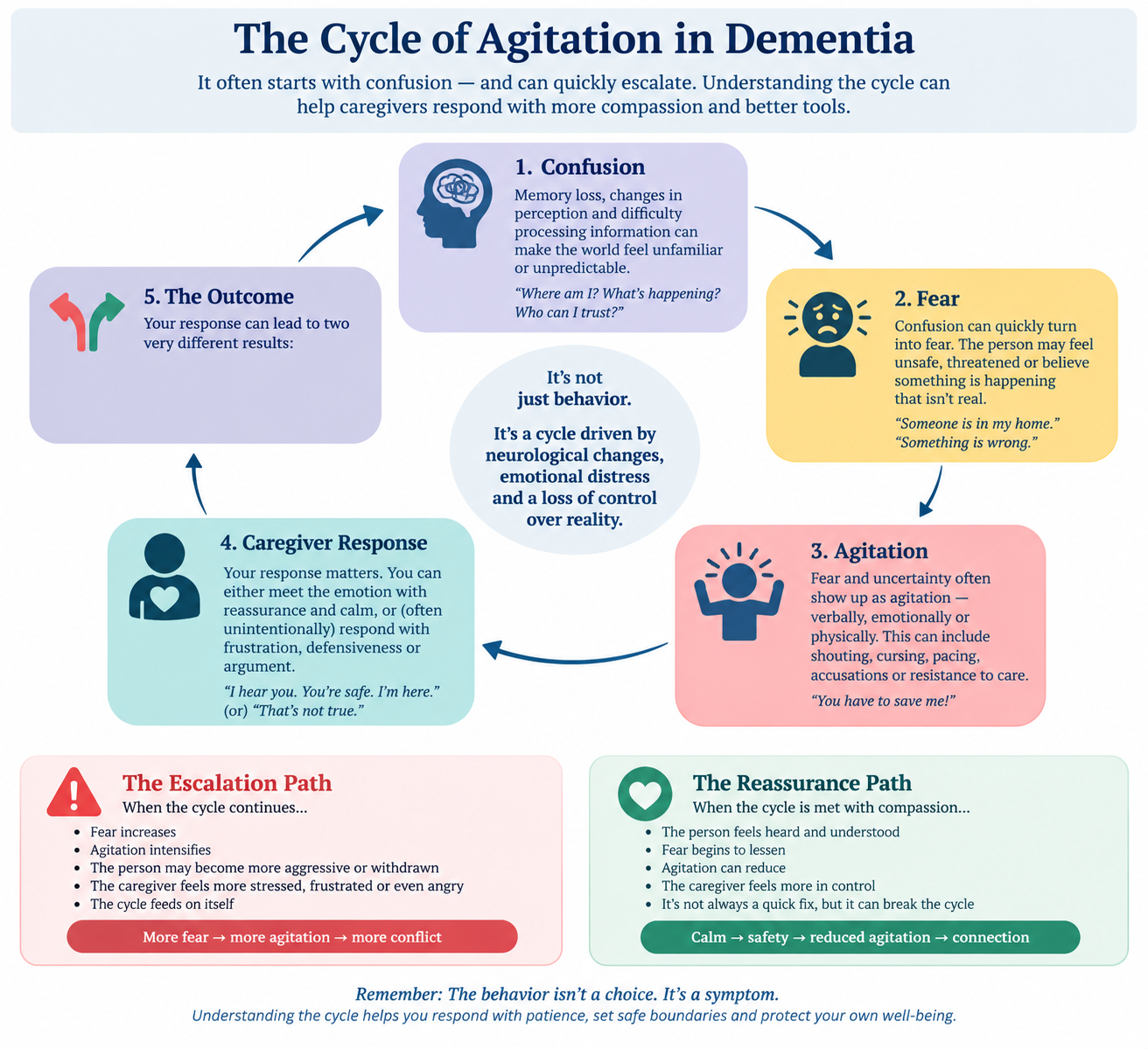
It can become a feedback loop: confusion creates fear, fear produces agitation, agitation produces confrontation, and confrontation can create even more confusion and fear.
Once you see that cycle, the caregiver’s response becomes particularly important.
Why Arguing About the Facts May Not Work
This has been one of the hardest lessons for me.
I am naturally inclined to solve problems by establishing the facts. Someone is breaking into your apartment? Let’s determine whether anyone is actually there. You think something was stolen? Let’s look for it. You believe someone is threatening you? Let’s establish what happened.
That approach makes perfect sense when everyone’s brain is processing the same information.
Dementia changes that equation.
If Mom’s brain is telling her that someone is in her apartment, presenting additional facts may not resolve the fear. Sometimes the better initial response is to acknowledge the emotion rather than argue about the belief.
Something as simple as, “That sounds frightening. You’re safe, and I’m here with you,” may be more productive than launching into an explanation of why the person she believes she saw couldn’t possibly have been there.
The goal isn’t necessarily to convince her that she is wrong. The immediate goal may be to make her feel safe enough to move past the fear.
Agitation Isn’t Always “Just Dementia”
This is an especially important point for caregivers.
A sudden change in behavior shouldn’t automatically be attributed to dementia.
Older adults with dementia can also develop delirium, an acute change in attention, awareness and cognition that can be caused by an underlying medical problem. Delirium can involve confusion, disorientation, agitation, aggression or hallucinations. NIA notes that delirium is particularly important to recognize because it can occur in people who already have dementia and can represent a significant medical problem. (National Institute on Aging)
Pain, infection, dehydration, constipation, medication changes, sleep disruption and other medical issues can contribute to sudden behavioral changes.
That means a person who is normally relatively calm but suddenly becomes extremely agitated, confused or difficult to redirect may need medical evaluation.
This distinction between chronic dementia symptoms and an acute change in mental status can be difficult for a family caregiver to make. That is one reason significant or sudden behavioral changes deserve attention from a healthcare professional.
When Agitation Becomes Aggression
There is also a point at which agitation becomes a safety issue.
Verbal agitation can include yelling, insults, accusations or threats. Physical aggression can include hitting, kicking, pushing, grabbing or throwing objects.
Understanding the neurological basis of these behaviors doesn’t mean caregivers have to accept dangerous situations.
Safety comes first.
The NIA recommends maintaining a safe distance when a person becomes aggressive, reducing potential hazards and seeking medical advice when aggressive behavior worsens. In an emergency, caregivers should seek emergency assistance and explain that the person has dementia. (National Institute on Aging)
Compassion does not require putting yourself in danger.
That may be an obvious statement, but caregivers sometimes need to hear it.
But What About the Caregiver’s Anger?

This is where the medical explanation meets the human reality.
- I do want to return the anger.
- No one should treat me so poorly.
If this were a business disagreement, the tough caregiver in me might dish out more of the same abuse. If another adult knowingly behaved that way toward me, I would have every reason to establish some pretty firm boundaries.
But this isn’t a business disagreement. This is a frightened old woman losing control—and she knows it. She just doesn’t know what to do about it.
That distinction doesn’t make the words hurt less. It does, however, change what I believe I should do with them.
My mother isn’t necessarily making a deliberate choice to be cruel. Her ability to interpret events, regulate emotions and control impulses may be compromised by neurological disease.
Understanding that doesn’t mean I have to pretend I’m unaffected.
It means I have to decide how to respond.
Emotional Regulation Is Part of the Caregiving Job
Dementia caregiving has taught me something unexpected about emotional regulation.
I have always tried to compartmentalize the stressors in my life. Keeping caregiving somewhat separate from the rest of my life helps prevent the stress from boiling over into other relationships.
There is my ordinary life, then there is caregiving. The two occasionally collide, but I try not to let one consume the other.
Lately, though, I have found another source of stress. I’m encountering emotional meltdowns from family members and strangers that remind me, in a completely different context, of what happens with Mom.
The comparison isn’t medical. Most people who lose their temper don’t have dementia, but after spending so much time dealing with agitation, accusations and emotional escalation, I find myself increasingly sensitive to those behaviors.
The exaggerated response. The inability to tolerate frustration. The immediate escalation. The expectation that someone else should absorb the emotional consequences.
After a while, it becomes exhausting.
Dementia Has Changed the Way I Think About Anger
Perhaps the biggest lesson is that emotion and behavior aren’t the same thing.
Mom may not be able to regulate her emotions the way she once did. Her brain is changing. Her perception of reality is changing. and her ability to understand and respond to what is happening around her is changing.
I have to account for that, however, I do not have the same excuse.
I may feel anger, frustration or resentment. Those feelings are human. What I do next is where responsibility enters the picture.
Caregiving forces me to practice that distinction repeatedly.
I can be angry without retaliating. I can establish boundaries without humiliating someone. I can recognize that Mom’s behavior is caused by disease without pretending that the behavior doesn’t affect me. And I can understand her without losing myself in her illness.
The Caregiver Needs Care, Too

There is a danger in focusing so completely on the person with dementia that the caregiver’s emotional health disappears from the equation.
Caregivers experience stress, grief, frustration, exhaustion and sometimes anger. The National Institute on Aging specifically acknowledges that caregivers can feel discouraged, sad, lonely, frustrated, confused or angry, particularly when the person they care for becomes angry or hurts their feelings. (National Institute on Aging)
That acknowledgment matters.
Sometimes caregivers feel guilty simply because they’re having a normal human reaction to an extraordinarily difficult situation. Caring about someone doesn’t mean you stop being human.
There is also a form of grief that can accompany dementia because the person is physically present while aspects of the relationship and personality are changing. (Hence the phrase, “The Long Good-bye.) Some days Mom is clearly Mom. Other days, it feels as though I am trying to reach her through layers of neurological disease.
Sometimes I am talking to my mother. Sometimes I am talking to dementia. And I often do not know which one will answer the phone.
“Never respond to an angry person with a fiery comeback, even if he deserves it…Don’t allow his anger to become your anger.”
― Bohdi Sanders

